 GBC AIR TECHNICAL SERVICES
GBC AIR TECHNICAL SERVICES
GBC AIR TECHNICAL SERVICES
Verum is GBC Air Technical Services Ltd's integrated airline operations system, built for OCC, crew control, disruption management, compliance and dispatch readiness. One control surface, modular architecture across six operational domains, full audit chain, engineered for real airline operations.
This is not a dashboard. It is the operating system for the OCC: the surface on which an airline's daily, live and predictive operations are executed, validated and recorded.
Verum is currently in beta. Capabilities are labelled honestly as Delivered, In Progress, or Planned as the platform moves toward production-ready deployment.
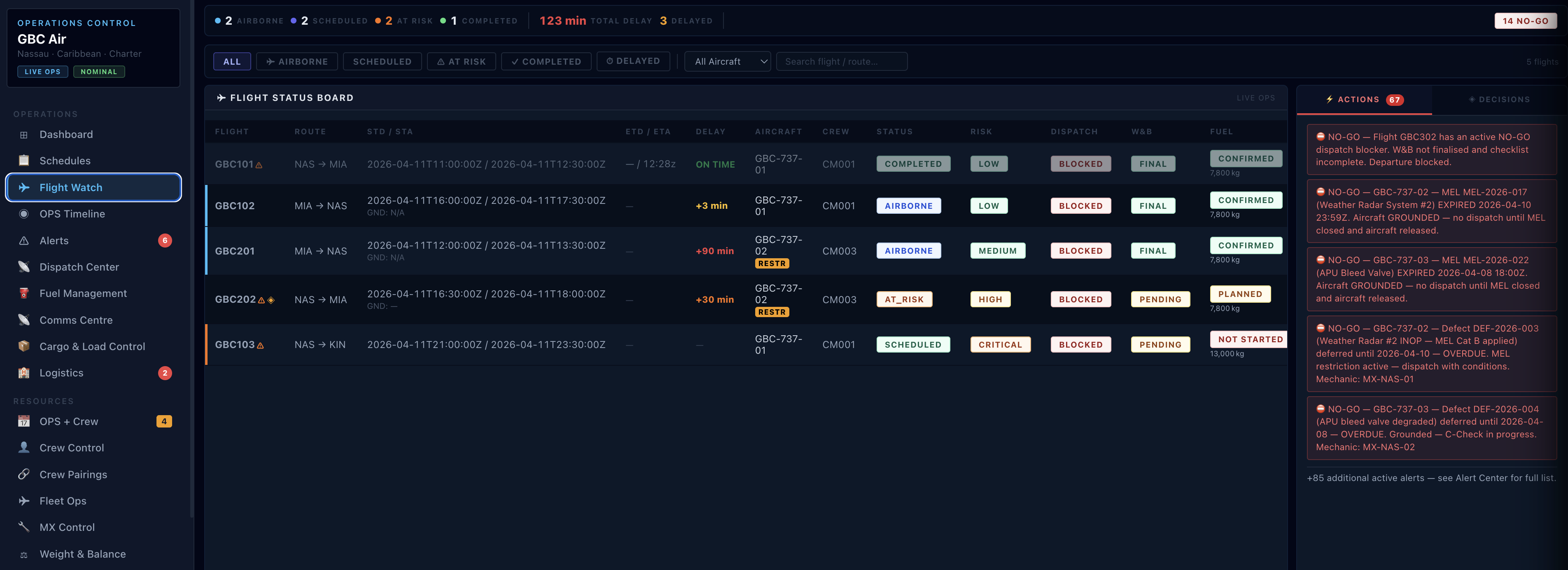
Aircraft cannot be in two places at once. Impossible timelines are blocked. Invalid sequence continuity is blocked. The system enforces before it informs, there is no "override and proceed" for safety and legality constraints.
Every recovery option passes through all three gates before it can be ranked. Unsafe options are excluded, not ranked lower. Illegal options are excluded, not shown with a warning. The gate is absolute.
Every safety- or schedule-affecting change is staged: PROPOSED → UNDER_REVIEW → APPROVED → EXECUTED. Every stage logged. Named authority. Named decision. Named alternatives rejected. The audit chain answers the post-event question before it is asked.
Dispatch release requires nine readiness gates to pass. Auto-release is permitted only when W&B is FINAL, the checklist is COMPLETE, and no CRITICAL or NO-GO alerts are open. All nine gates must clear. There is no partial release.
The nine gates cover: aircraft readiness, crew legality, weight & balance, fuel state, cargo documentation, flight documentation, pavement/ACN compliance, crew logistics and FDP. Each gate has a binary state: open or closed. The dispatch surface shows the live gate state across all active flights.
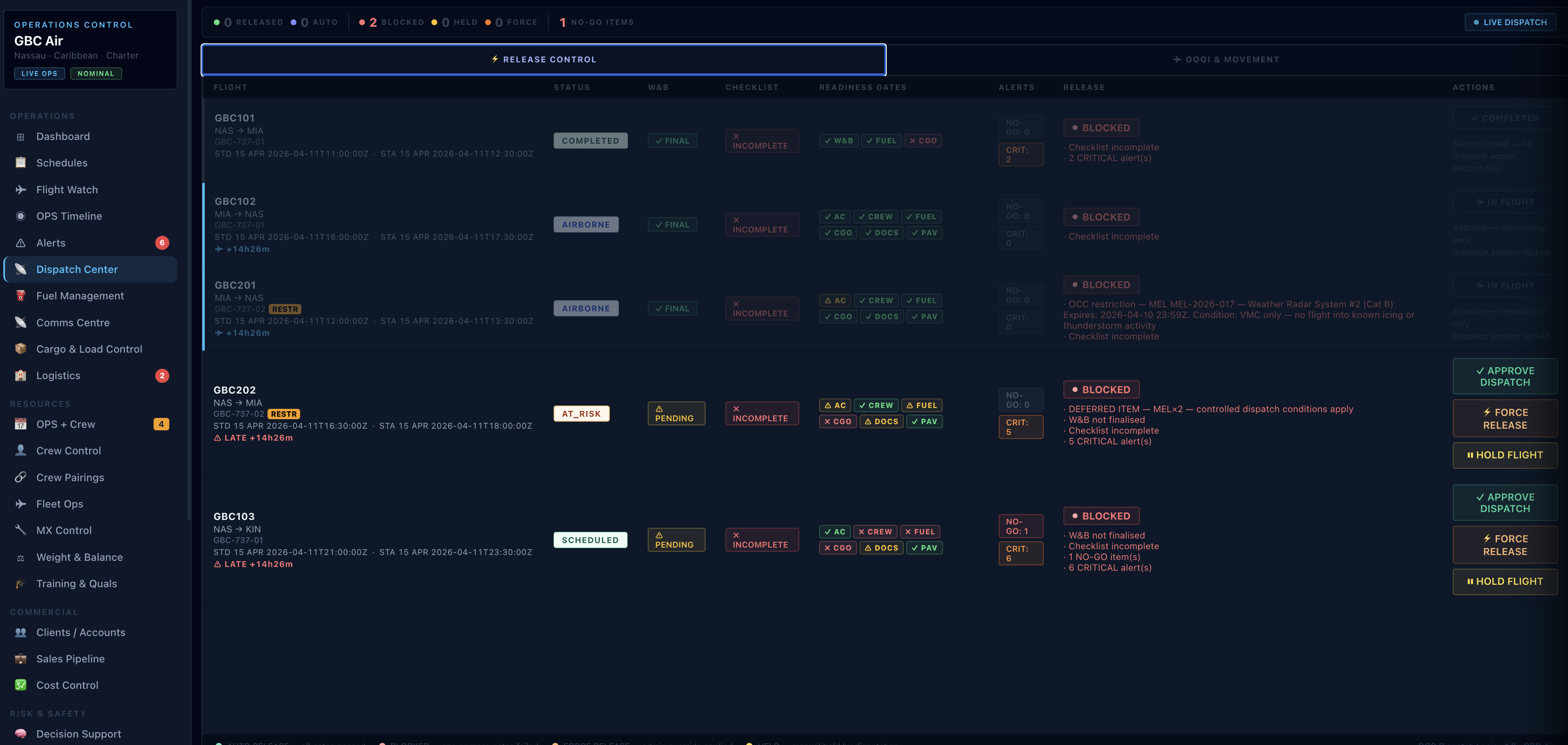 DISPATCH CENTER
Nine readiness gates. Auto-release conditions enforced. NO-GO and CRITICAL conditions block release independently of gate state.
Crew assignments are validated against the applicable FTL framework before any change reaches the published roster. The system prevents illegal pairings from being set — not notifies after the fact. Rolling hours and rest-period tracking run continuously across the crew establishment.
The Crew Control surface shows crew state (on duty, standby, rest, illegal), current FDP position, accumulated rolling hours across 28-day and 365-day windows, and upcoming duty obligations. Crew swap proposals are filtered against the three-gate constraint model before ranking.
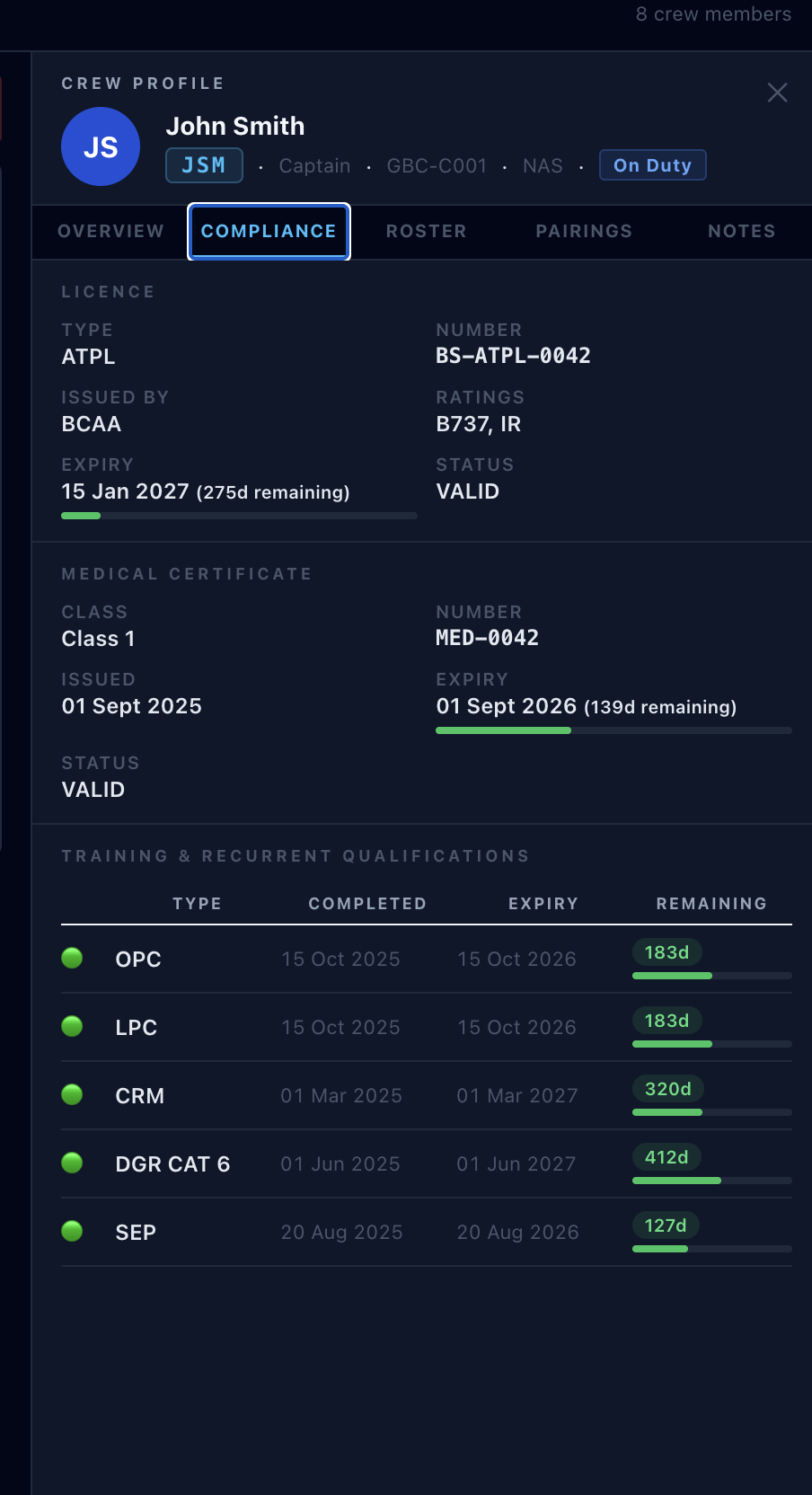 CREW CONTROL
FDP legality, rolling hours, standby management and crew assignment, gated before the schedule updates.
The Decision Queue surfaces ranked recovery options for disrupted operations. Every option passes through the three-gate filter (Safety, Legality, Feasibility) before it can be ranked. Options that fail a gate are excluded, not ranked lower. The ranked list presented to the controller contains only operationally valid options.
Human approval is required at every stage. The approval class (STANDARD, SENIOR_OCC, DUTY_MANAGER or COMMERCIAL) is set by the nature of the change. Every approval creates a DEC-NNN decision record and an APR-NNN approval record, both appended to the immutable operational event log.
Weight and Balance is calculated with full CG envelope enforcement. Loadsheet state progresses through DRAFT → PROVISIONAL → FINAL. Dispatch is blocked until the loadsheet reaches FINAL state and the CG envelope is confirmed within limits.
The W&B surface covers cargo load, ULD configuration, pantry and cabin items, passenger weights (where applicable), fuel state and running take-off weight calculations. Any change that would take the aircraft outside its certified envelope is blocked before it can be saved.
The Predictive Risk Engine evaluates forward operational risk across three time horizons (three hours, six hours and twelve hours) and surfaces recommended prevention actions ahead of projected disruption impact. The engine evaluates crew FDP approaching limits, maintenance holds, slot constraints, connection risks and schedule tension across the active fleet.
Predictive risk outputs are presented in the Flight Watch risk strip and the dedicated Predictive Ops surface. Each risk item carries a severity classification, a time-to-impact estimate and a recommended action. Recommended actions are pre-filtered through the three-gate constraint model before surface.
Verum is not a single tool. It is a multi-domain operational environment covering OCC operations, crew management, dispatch, safety, compliance, disruption recovery and commercial control, all sharing a single data model, a single audit chain and a single constraint engine.
Unified OCC command view. All active flights, fleet state, crew coverage, open alerts and operational actions, reflecting live system state across every linked module. The primary situational awareness surface for the flying day.
Rotation planning and publication with pre-departure constraint checks. Rotation continuity enforced, an aircraft cannot depart a station it has not arrived at. Sequences enter a pre-release gate before publishing to the live operational plan.
Real-time monitoring of all airborne and ground-state flights. Integrates ATC/MET data, tracks departure readiness, flags delay-propagation risk and surfaces MEL and NO-GO conditions. The operational truth surface for the flying day: SCHEDULED → BOARDING → DEPARTED → AIRBORNE → LANDED → BLOCKED.
Gantt-format presentation of rotation sequences, crew duty windows and MX holds simultaneously. Identifies structural conflicts: duty limit overruns, maintenance hold overlaps and slot constraints — across the full flying programme. Conflict resolution triggers the Decision Queue.
Prioritised operational signals with ranked recovery options. Severity classification: INFORMATIONAL · WARNING · CRITICAL · NO-GO. CRITICAL and NO-GO alerts independently block dispatch release. Alerts are not dismissed, they are resolved, with a resolution record appended to the audit chain.
Nine-gate pre-departure release surface. Gates cover: aircraft readiness, crew legality, W&B state, fuel, cargo documentation, flight documentation, pavement compliance, crew logistics and FDP. Auto-release conditional on all nine gates green, W&B FINAL and zero CRITICAL/NO-GO alerts. Three conditions. All required.
Uplift planning against planned flight fuel requirements and company policy minimums, provider SLA management, variance tracking and per-flight cost attribution. Fuel orders built against live fleet consumption data. Variance between planned and actual uplift logged against the flight record.
MVT message processing, CPDLC proxy and stakeholder notification routing. MVT messages generated from flight state changes and routed to handler, crew and AOC parties. Message log maintained with delivery confirmation tracking. Supports ACARS proxy integration.
Manifest management, ULD allocation, DGR segregation compliance and AVSEC state linked to the live flight. Cargo loads validated against ULD limits and DGR requirements. Load changes trigger W&B recalculation and Dispatch gate state updates automatically.
Hotel accommodation, crew transport and per-diem management for rotating and displaced crews. Logistics workflows triggered by crew disruption events and IRROPS activations. Crew authorisations tracked with cost attribution to the originating operational event record.
CAMO-grade onboarding sequence for new airframes from delivery to first revenue flight. Covers entry-to-service documentation, airworthiness record initialisation, MEL structure build, crew type-rating alignment and initial MX programme linkage. Each stage gated before progression.
Disruption recovery coordination with delay impact visibility and structured decision support. IRROPS activates when disruption breaches defined impact thresholds. Recovery options generated, filtered through the three-gate model and ranked by feasibility. Crew re-accommodation, passenger handling and slot recovery coordinated within a single workspace.
EC 261/2004 exposure tracking and duty-of-care management across disrupted operations. Passenger eligibility assessed per flight against delay duration, cancellation reason and downgrade classification. Right-to-care obligations, re-routing options and documentary evidence tracked through the disruption lifecycle. Human confirmation required at every stage, no autonomous passenger decisions.
Integrated crew operations desk linking flight sequences, rostered crew, standby pool and real-time crew tracking. The operational hub for crew-facing day-of-operations management. Presents crew state, current assignment and duty window across the full establishment on a single surface.
Live crew assignment with FDP legality validated at point of assignment. Prevents illegal assignments from reaching the published roster, does not notify after the fact. Rolling hours tracked continuously per crew member across 28-day and 365-day windows. Standby activation managed against callout windows and current rest state.
Legality-validated multi-leg pairing sequences with configurable FTL/FDP enforcement. Pairings define crew assignments across multi-leg rotations. Each pairing validated against rest requirements and base constraints before publication. Open pairings flag coverage gaps in advance of the flying day.
Aircraft utilisation management, MEL status, AOG events and MX windows tied directly to Dispatch readiness. Surfaces each aircraft's operational state: airworthy, MEL-limited, maintenance hold or AOG. MX windows integrated into the OPS Timeline and drive dispatch gate checks for affected rotations.
Engineering dashboard for defect management and workpack tracking. Defects raised from Flight Watch and Tech Log. Tracks open defects, assigned workpacks, deferred MEL items and completion states. MX event completion clears the associated MEL item and updates Fleet Ops state and dispatch gates.
CG, MTOW, MZFW, MLW and ULD distribution, continuously validated against the certified envelope. Loadsheet state machine: DRAFT → PROVISIONAL → FINAL. Dispatch blocked until FINAL is achieved. Any configuration change that would breach the CG envelope is blocked before save. Cargo load changes propagate automatically to the Dispatch gate.
Qualification matrix, recurrent training currency and licence expiry enforcement. Tracks crew and ops personnel qualifications against operational requirements. Expiring qualifications flagged in advance. Assignment constraints applied at Crew Control for personnel with expiring or lapsed type ratings or medical certificates.
Staff directory covering crew, operations and support personnel. Role assignments, qualification profiles and document expiry tracking across the operator's full establishment. Crew qualification visibility integrated with scheduling, pairing and dispatch readiness workflows. Personnel records linked to training history, duty log and certification status.
Per-flight crew cost calculation integrated with flight duty periods and crew assignments. Duty pay, sector allowances, hotel and per-diem costs accumulated per rotation and aggregated to roster period level. Read-only cost layer: figures feed directly into flight P&L and fleet cost reporting without modifying roster or duty records.
Customer database with contracts, service history and relationship records tied to charter or ACMI operations. Client records link to quotation history, confirmed bookings and post-flight performance reporting. Operational performance data accessible at the client record level for account review.
Quote workflow tied to live fleet capacity, W&B payload feasibility and crew availability at time of quote. A quotation cannot be generated for a flight the fleet cannot technically operate, capacity is validated against real aircraft availability, not theoretical fleet size.
Margins, flight-level P&L and operational cost attribution. Fuel uplift, crew logistics, handler charges, slot fees and disruption costs attributed at flight and rotation level. Per-flight and per-rotation P&L presented against revenue for operational management review.
Live exposure map of disruption impact across the active rotation plan. Evaluates propagation of current disruptions, surfaces at-risk rotations, estimated delay cascade and operational resource impact. Network state updated continuously as disruption conditions change across the fleet.
Human-approval queue for every recovery option and schedule change with operational impact. Enforces the approval class architecture: STANDARD · SENIOR_OCC · DUTY_MANAGER · COMMERCIAL. No change executes without completing the full PROPOSED → UNDER_REVIEW → APPROVED → EXECUTED state machine.
Constraint-aware recommendations with full explainability. Every recovery option ranked against the three-gate model: Safety → Legality → Feasibility. Each recommendation presented with constraint evaluation, impact analysis and alternatives considered. The controller sees the reasoning, not just the ranking.
Forward risk projection across the network and rotation plan at 3h, 6h and 12h horizons. Evaluates crew FDP approach, MX hold impact on upcoming departures, slot constraint pressure and connection risk. Prevention actions surfaced and pre-filtered through the three-gate model before the disruption materialises.
Safety reporting, hazard identification, ICAO 5×5 risk register and occurrence trend analysis. Provides the SMS framework for safety reporting and hazard logging. Hazards classified against the ICAO 5×5 matrix. Occurrence trends tracked for SPI/SPT reporting and safety management oversight.
Fatigue Risk Management System with bio-mathematical modelling compliant with EASA guidance. Evaluates cumulative fatigue risk against crew scheduling data. FRMS outputs inform scheduling decisions, standby window management and reduced-rest approval evaluation. Fatigue risk visible at individual crew and establishment level.
METAR, TAF and NOTAM briefings bound directly to each flight. Briefings generated per flight against destination and alternate TAFs, en-route significant weather and applicable NOTAMs. Briefing acknowledgement logged against the flight record as part of the dispatch gate sequence. Prevents departure without documented met awareness.
Station database with handling charges, curfew windows, slot constraints and operational limitations. Provides the aerodrome data layer for all operational calculations: slot periods, runway PCN/ACN pavement limits, noise abatement procedures and ground handler SLA parameters applicable to each rotation.
Controlled document library with structured content editing, version lifecycle and aviation revision bars. OM-A, OM-B, OM-C, OM-D, AFM supplements, MEL and CDL held in a version-controlled repository. Per-revision lifecycle: DRAFT → REVIEW → APPROVED → PUBLISHED. Four-eyes section approval enforced. Aviation revision bars computed against prior published revision. Expiry tracking with pre-expiry alerts.
Immutable event log of every operational action and decision. Records every state change, alert, approval, dispatch release and resolution event, with timestamp, controller identity and linked module context. The log is append-only: records cannot be amended or deleted after creation. The audit chain answers post-event questions before they are asked.
Operational and regulatory export packages with audit-grade traceability. Covers flight operations records, crew duty reports, fuel variance analysis, disruption incident records and safety occurrence reporting. All reports generated from live operational data and carry the full audit chain provenance of every underlying record.
AVSEC programme management, access control records and security compliance workflow. Covers AVSEC personnel records, security programme documentation, screening confirmation and security-related NOTAM integration. Role-based access enforcement maintained per operational role across the platform.
Management of Change workflow, compliance oversight procedures, controlled approvals, audit trail management, safety governance and operational accountability framework. Provides the formal structure for regulatory compliance documentation: MoC, regulatory finding management and accountable manager approval chains aligned to EASA and ICAO oversight requirements.
Continuous IOSA Ed.17 readiness monitoring mapped against ISARP standards. Evidence index links operational procedures to specific ISARP requirements. Compliance gaps surface as priority alerts in the OCC alert bus. Pre-audit readiness assessment and structured audit pack generation. Not an IOSA registration or certification service, readiness preparation and monitoring only.
Structured operational change management from proposal through risk assessment, review, approval, implementation and effectiveness check. ICAO Annex 19-aligned lifecycle. Approval enforced only after recorded risk assessment where required. Changes linked to manual revisions, SMS hazard records and compliance findings: full traceability chain from trigger to closure.
Compliance findings register and corrective/preventive action management. Full finding lifecycle from identification through CAPA assignment, implementation and closure verification. Linkable to internal audit runs, manual revisions, MoC entries and IOSA corrective action records. Pending CAPA expiry tracked and surfaced as compliance alerts before breach.
Structured compliance oversight panel for Accountable Manager reviews. Aggregates SPI/KPI data, safety metrics, open findings and training status into a single executive briefing surface. AM Meeting Mode presents the compliance state across all operational domains in one auditable view. All outputs are advisory, every recommendation requires human review and approval before any action is taken.
Operator-wide configuration, policy rules and role permissions. Defines the operational baseline for the VERUM instance: aircraft type configurations, FTL policy parameters, alert severity thresholds, approval authority matrices and user role permissions. Changes to Ops Settings require senior authority approval and are logged in the audit chain with named authority and effective date.
Verum covers the full operational domain from pre-flight planning to post-flight reporting. Verum includes implemented multi-AOC architecture, including aircraft-to-AOC mapping, AOC status checks, crew approvals per AOC and FTL framework resolution. This allows the platform to support operators across multiple AOCs, regulatory frameworks and jurisdictions.
Not an IOSA-certified product · IOSA Readiness Layer is a readiness monitor, not a certification service · Implemented multi-AOC and AOC / FTL regulatory logic · AI outputs are advisory only, critical operational actions require human review, approval and traceability · Verum is currently in beta and is being developed toward production-ready deployment through secure cloud/server infrastructure, controlled data management and role-based operational access